Day 3 of OneWe Reach’s 10th Annual Conference brought together some of the most pressing issues facing life sciences today: an evolving leadership landscape, shifting investment priorities, accelerating scientific innovation, and the growing demand to demonstrate meaningful patient impact.
Across mainstage presentations, fireside chats, and candid panel discussions, industry executives, investors, innovators, and emerging leaders shared their experiences, challenged conventional thinking, and offered practical insights into what’s ahead. The conversations were wide-ranging, but a common theme emerged: Progress depends on how effectively we connect our expertise, resources, and relationships to create lasting value.
The day began with powerful lessons from Wall Street veteran Carla Harris and moved into candid discussions about pharmaceutical investment, cross-generational leadership, biotechnology’s next deal cycle, and the growing role of artificial intelligence in healthcare. While the conversations covered very different territory, they shared a common message: The future of life sciences depends on leaders who are willing to challenge established thinking, build meaningful relationships, and make decisions that translate innovation into real-world impact.
Here are five takeaways worth carrying forward.
1. Nobody Has the Rule Book. That’s an Opportunity to Lead.
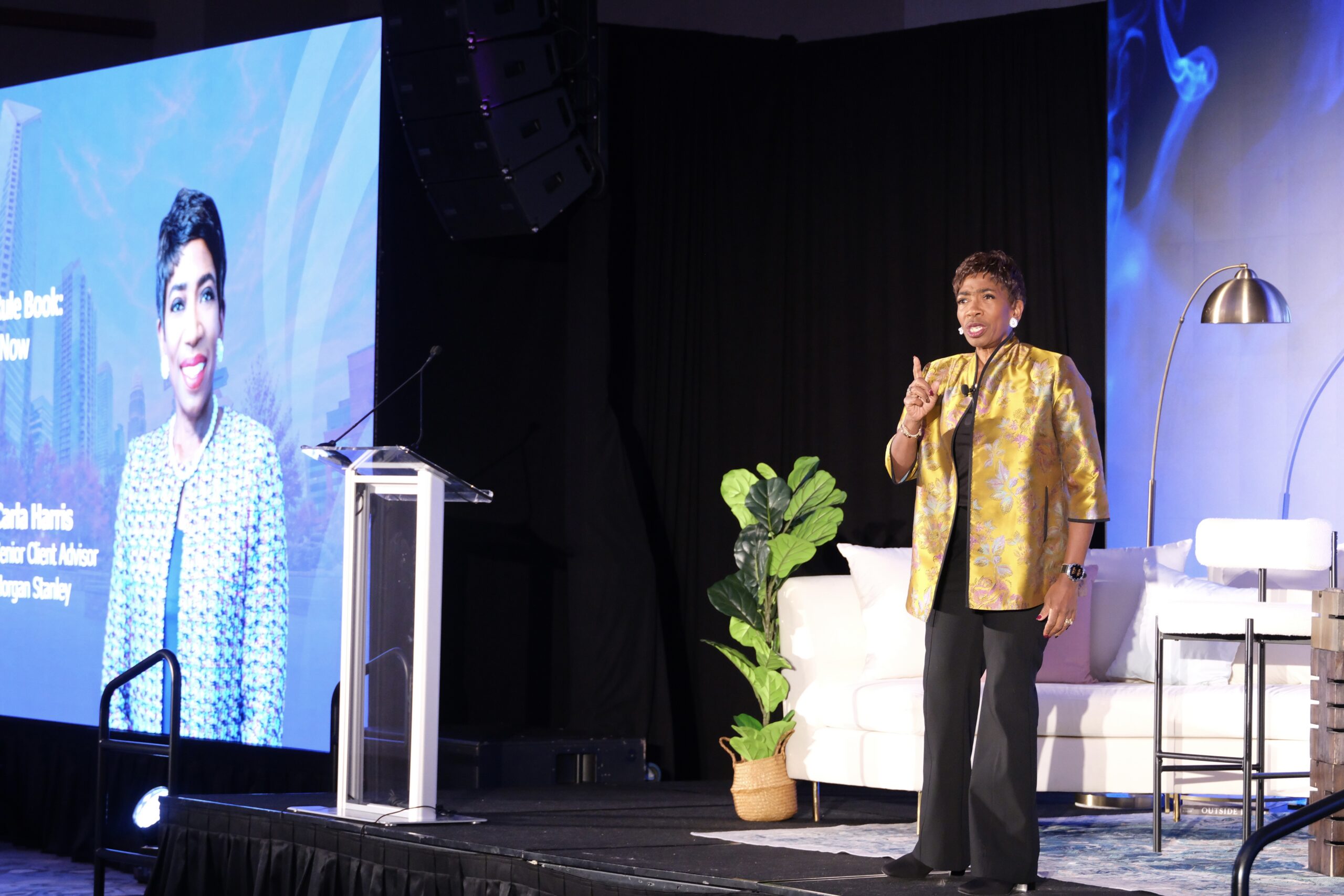
When Carla Harris took the mainstage for Nobody Has the Rule Book: Strategize to Win, Now, she made one thing clear: The uncertainty facing today’s leaders creates an opportunity to influence what happens next.
Introduced by Paul Rowe, MD, ATSF, Harris drew on nearly four decades of experience at Morgan Stanley to share her signature leadership “pearls,” combining memorable stories, sharp humor, and practical career advice.
Earlier that morning, during an intimate VIP fireside chat moderated by Howard Matalon, Esq., Partner at Olender Feldman, Harris had explored many of those lessons in greater depth, including the importance of managing professional perceptions, building strategic relationships, and knowing when to advocate for yourself.
One of her strongest messages concerned the difference between performance currency and relationship currency. Doing excellent work helps professionals establish credibility, particularly early in their careers. But as they advance, relationships become increasingly important because promotions, opportunities, and leadership decisions are often made when the individual being considered isn’t in the room.
Harris encouraged attendees to identify the people who know their work well enough to advocate for them when those decisions arise. She also challenged leaders to embrace authenticity, build trust through consistent actions, and create opportunities for others to succeed.
Her closing message was particularly timely for an industry navigating unprecedented change.
“Your authenticity is your distinct competitive advantage. Nobody can be you the way that you can be you.”
— Carla Harris
The takeaway: Identify three qualities you want associated with your leadership, invest in relationships beyond your immediate team, and make sure someone can speak to your contributions when opportunity comes knocking.
2. The Business of Healthcare Is Changing. So Is the Meaning of Investment.
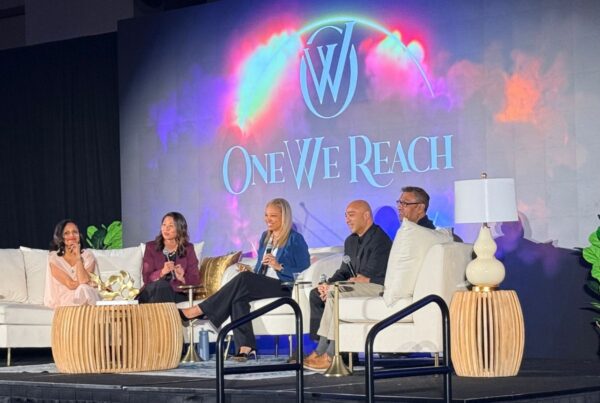
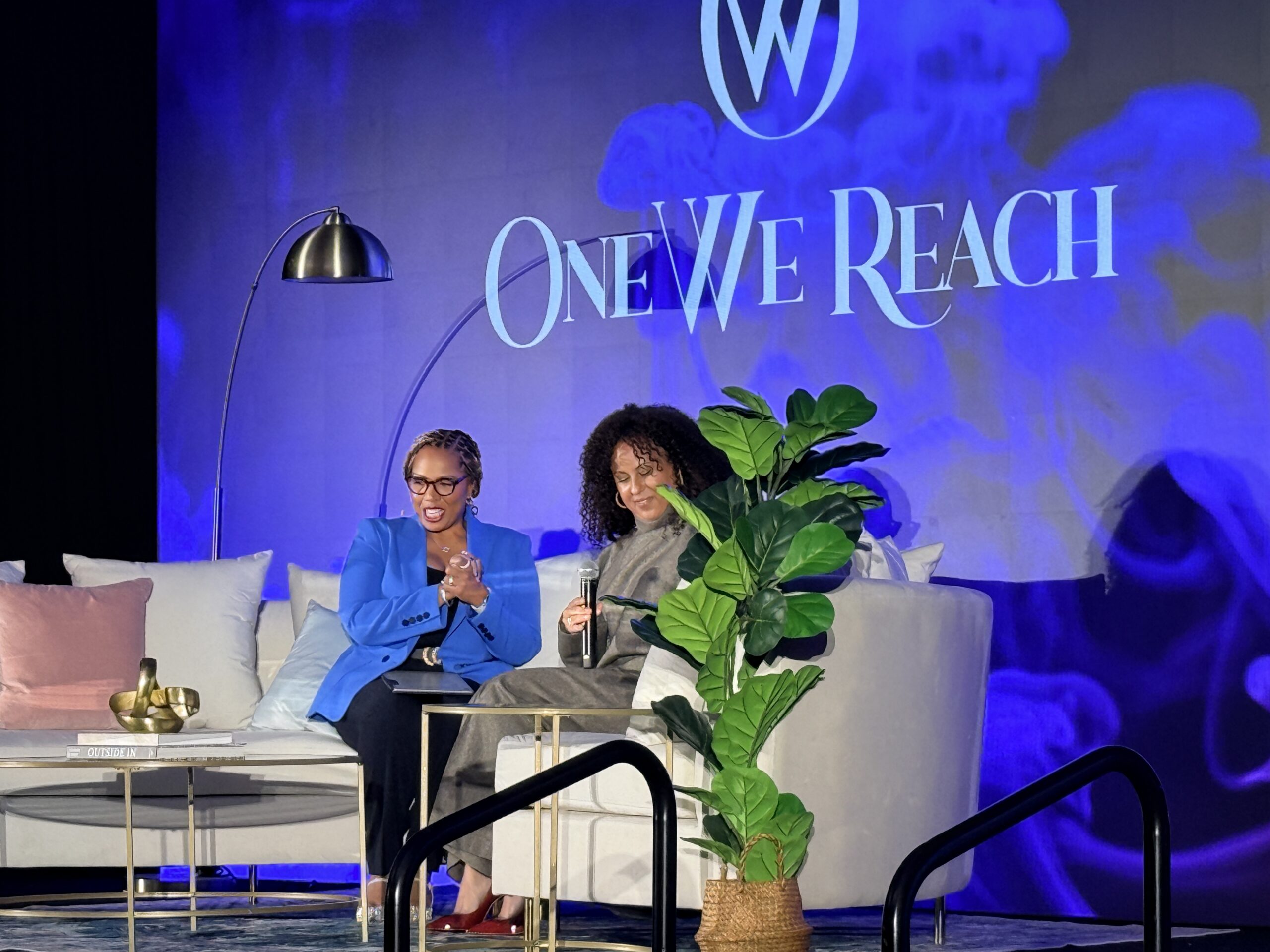
One of the day’s most personal conversations took place in a setting designed to feel like a living room, a fitting tribute to the conversations that helped launch OneWe Reach a decade ago.
During Capital, Care, and Consequence: How Pharma’s Impact Investments Are Reshaping the Business of Healthcare, sponsored by Merck, OneWe Reach Founder and President Dr. Charlotte Jones-Burton sat down with Kalahn Taylor-Clark, Vice President and Head of Social Impact & Sustainability at Merck.
Taylor-Clark shared how the loss of both parents to cancer helped shape her commitment to improving health outcomes. That personal mission has guided her career through academia, public policy, and the pharmaceutical industry, where she now works to connect social impact with business strategy.
Much of the discussion focused on a shift in how pharmaceutical companies approach corporate giving. Taylor-Clark described moving beyond traditional charitable donations toward strategic investments that produce measurable improvements in health outcomes while supporting long-term business sustainability.
She highlighted Merck’s impact venture fund, longer-term community investments, and Merck for Mothers, which she said has reached more than 40 million women.
But some of the most memorable insights came from her experiences working directly with community organizations. She spoke about the importance of listening before developing solutions, building relationships that extend beyond annual funding cycles, and measuring changes in behavior and health outcomes rather than activities alone.
“Innovation is nothing without the access to it.”
— Kalahn Taylor-Clark
The conversation also reinforced an important leadership lesson: You don’t need the most senior title to create meaningful change. Taylor-Clark shared how collaboration, strategic alliances, and knowing when to champion someone else’s leadership helped her advance initiatives that might otherwise have struggled to gain traction.
The takeaway: Whether you’re developing a new program, evaluating a partnership, or seeking investment, start by understanding the people you’re trying to serve. Then establish measurable outcomes that connect organizational value with meaningful patient impact.
3. Credibility Is Tested Most When Things Don’t Go According to Plan.
What happens when a colleague dismisses your contribution, a manager withholds important feedback, or a client discovers a critical mistake?
Those were among the real-world scenarios explored during Poise Under Fire, a lively panel moderated by LaToya Coffey, PhD, Senior Vice President of Strategy & Operations at Annexon Biosciences and Vice President of OneWe Reach. Featuring Tanya Swift, Corinthian Burton, Yasmeen Walker, Louvel Fauntroy, and Miriam Muley, the conversation examined emotional intelligence through the experiences of professionals at different career stages.
Panelists shared how they had navigated broken trust, difficult feedback, unexpected client challenges, and moments when their credibility was questioned. The stories were refreshingly candid, and at times humorous. They also illustrated how differently professionals can interpret the same workplace behavior. For some experienced leaders, professionalism was shaped by environments where long hours, hierarchy, and constant availability were expected. Younger colleagues described placing greater emphasis on transparency, flexibility, work-life boundaries, and understanding the purpose behind assignments.
Rather than treating those differences as obstacles, the discussion highlighted what happens when generations become more intentional about learning from one another. One particularly useful lesson came from the discussion about accountability. When something goes wrong, leaders can protect relationships by acknowledging the problem, communicating transparently, and arriving with a plan to make things right.
The panel also explored how managers can create environments where employees feel comfortable asking questions, admitting mistakes, and demonstrating their capabilities without constant supervision.
The takeaway: When pressure rises, focus on how you communicate. Acknowledge the issue, clarify expectations, and work toward a solution. And when leading across generations, be willing to reconsider whether the workplace standards you inherited still serve your team.
4. The Next Biopharma Breakthrough Needs More Than Great Science.
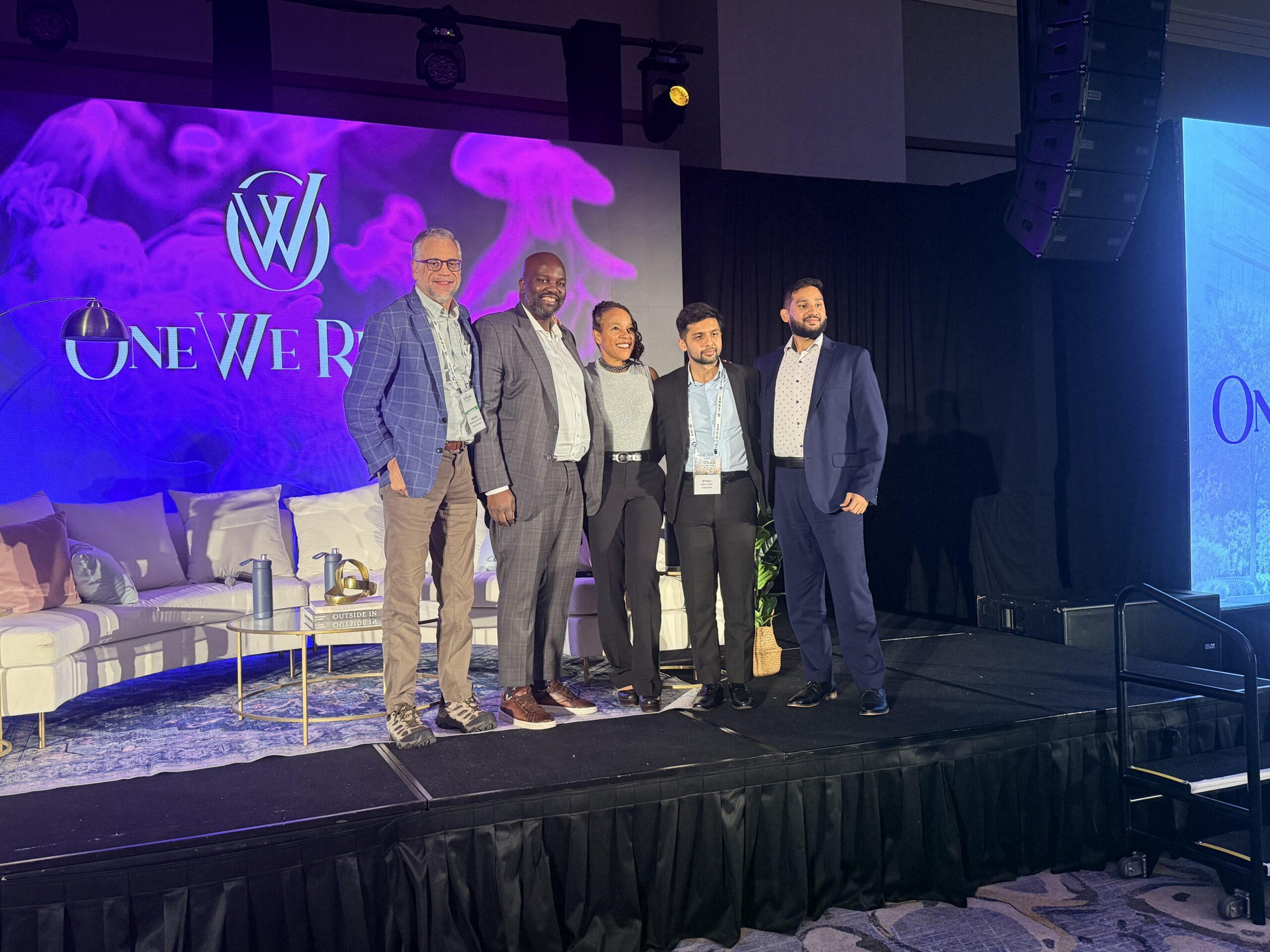
Scientific innovation continues to accelerate, but getting promising treatments through development and into patients’ hands is becoming an increasingly complex financial challenge. That tension drove a forward-looking discussion moderated by Ibraheem Alinur, Vice President at 2Flo Ventures, featuring Jeff Raphael, Richard Colvin, MD, PhD, Irtaza Haider, and Rhonda Wallen.
The panel explored how investment priorities have shifted since the biotech financing boom of 2021, with investors increasingly favoring more mature assets that offer clinical evidence and clearer paths to commercialization. That shift creates challenges for early-stage companies, particularly those pursuing novel technologies or therapeutic areas that have historically been underfunded.
China’s growing role in biotechnology emerged as one of the most interesting developments to watch. Panelists discussed how sustained investment, scientific talent, and lower development costs have created new opportunities for global partnerships and licensing arrangements. At the same time, they acknowledged important questions about clinical data quality, regulatory requirements, and the applicability of research across different patient populations.
Women’s health was another major focus. Rhonda Wallen and Richard Colvin examined the encouraging growth in therapeutic innovation alongside the difficulty of securing financing for complex development programs, including treatments for conditions affecting pregnant women.
The conversation also explored cell and gene therapy, where scientific advances continue to outpace solutions for manufacturing, delivery, reimbursement, and scalability.
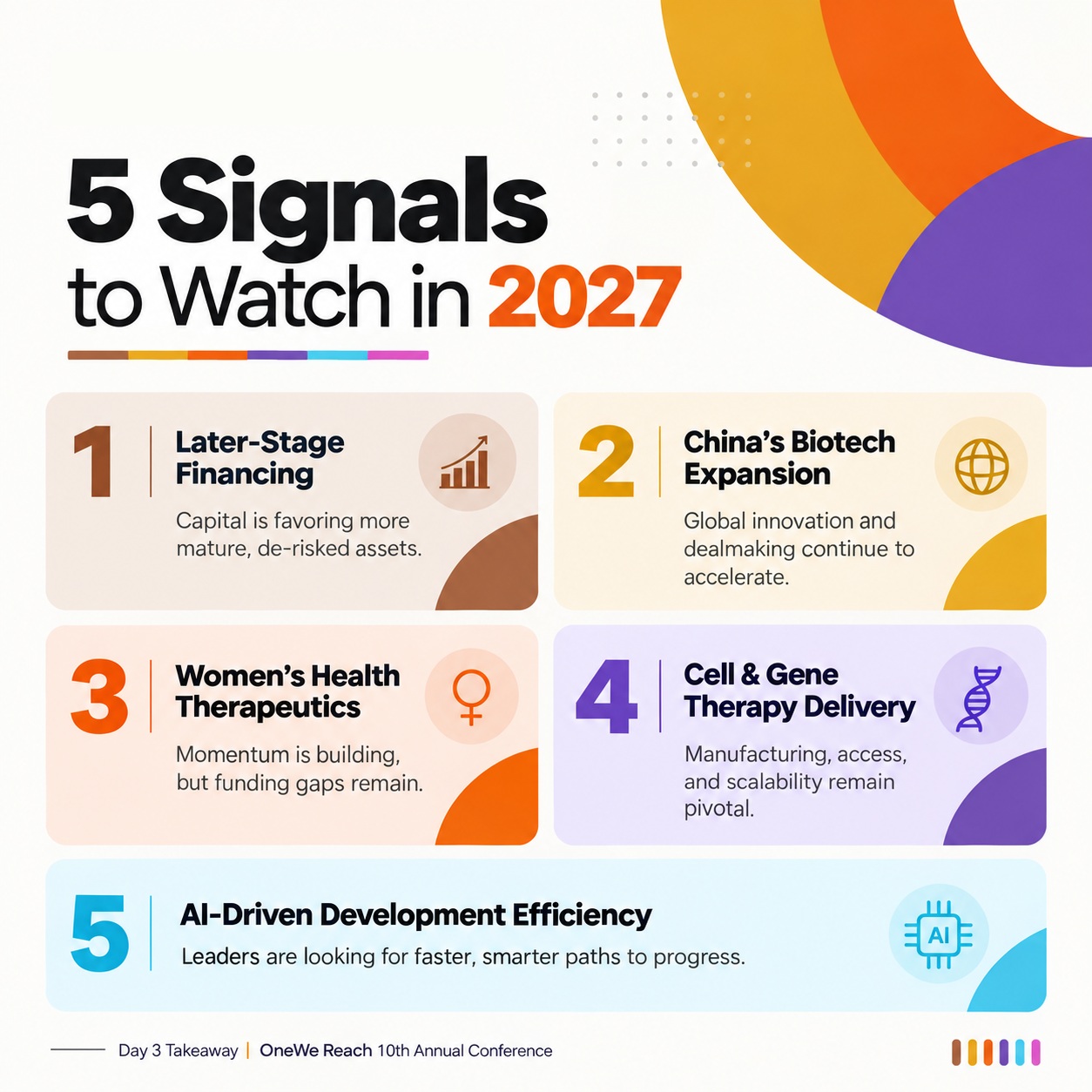
Not everyone agreed on how quickly these challenges would be resolved, which made the discussion especially valuable. It offered attendees a more realistic picture of the tradeoffs that investors and biopharma leaders will face heading into 2027.
The takeaway: Scientific potential is only one part of an investment decision. Leaders need to understand the financing, regulatory, manufacturing, and access considerations that determine whether a promising therapy can successfully reach patients.
5. Healthcare AI Has Reached Its Prove-It Moment.
The day’s conversation about AI began with an unexpectedly revealing moment. Attendees were asked how confident they felt that AI technologies influencing their healthcare had been tested on people like them.
Very few hands went up.
That response set the stage for a candid discussion moderated by Rod Cotton, MBA, Board Director and Venture Partner at Castle Biosciences and 2Flo Ventures, featuring Bola Oyegunwa, PhD, MBA, MMB, of Labcorp; AJ Rosenthal of General Genomics; and Mel Hayes of AiRare at Lumiio US. Each panelist brought a personal connection to the work, from family experiences with serious illness to witnessing the challenges faced by patients navigating complex healthcare systems. Their discussion moved quickly from those human stories into the practical realities of AI implementation.
Panelists shared examples of AI being used to support earlier disease detection, predictive analytics, more efficient diagnostic testing, and improved access to complex health information for patients managing chronic conditions. But they also challenged attendees to look beyond promising demonstrations and ask whether these technologies are delivering meaningful improvements in care.
Who was represented in the data used to develop the model? How does the technology perform across different populations? Are patients involved in designing the solutions? And what evidence demonstrates that the investment is producing value?
One particularly memorable point concerned return on investment. The panel argued that AI should be evaluated with the same discipline as any other major business investment: Identify the problem, assess possible solutions, establish measurable goals, and determine whether the technology actually delivers.
The conversation also addressed patient privacy, responsible data governance, and the importance of keeping clinical judgment and human relationships central to care.
The takeaway: Before investing in another AI tool, ask what problem it solves, whose needs shaped its design, how its performance has been validated, and what measurable difference it makes for patients.
The Thread Connecting It All: Leadership That Turns Possibility Into Progress
Looking across Day 3, it’s striking how often the same ideas surfaced in conversations that, on the surface, seemed to have little in common.
Carla Harris spoke about the courage to lead when familiar rules no longer apply. Kalahn Taylor-Clark challenged the industry to think differently about capital and community investment. The Poise Under Fire panel explored the relationships and communication skills that help teams navigate uncertainty, while the discussions on biotechnology and AI examined the practical decisions that determine whether innovation fulfills its promise.
Together, they offered a useful reminder that the future of life sciences will be shaped by much more than scientific advancement.
It will depend on how organizations allocate resources, how leaders build trust, how teams work across traditional boundaries, and how consistently the industry keeps patients at the center of its decisions.
As OneWe Reach celebrates its 10th Annual Conference, these conversations reflect the value of bringing professionals from across the life sciences ecosystem into the same room. Different experiences and perspectives create opportunities to challenge assumptions, share practical solutions, and build relationships that extend well beyond the conference.
And perhaps that’s the most important takeaway from Day 3.
We have more opportunities than ever to influence what comes next. The challenge now is to turn those opportunities into action.