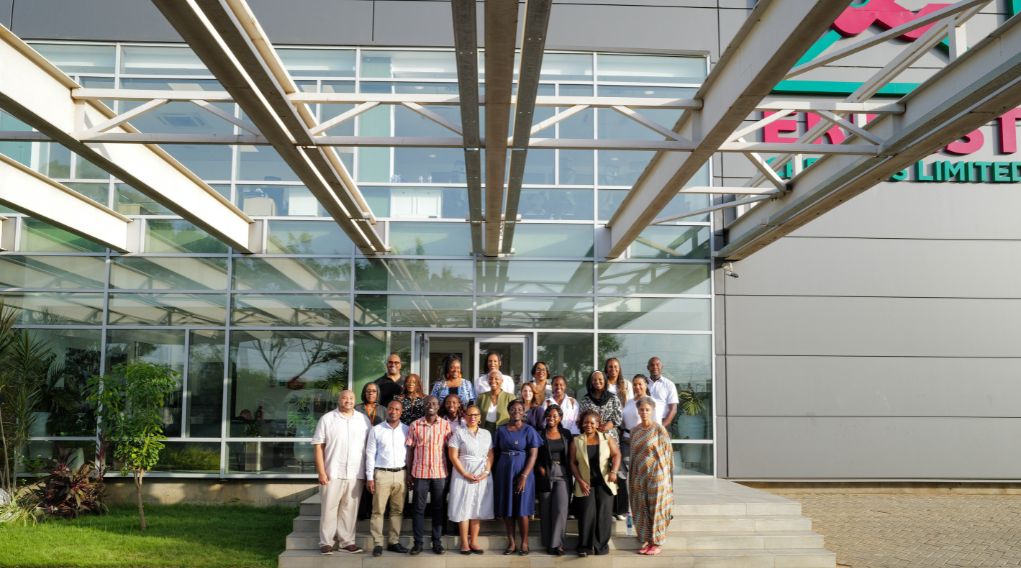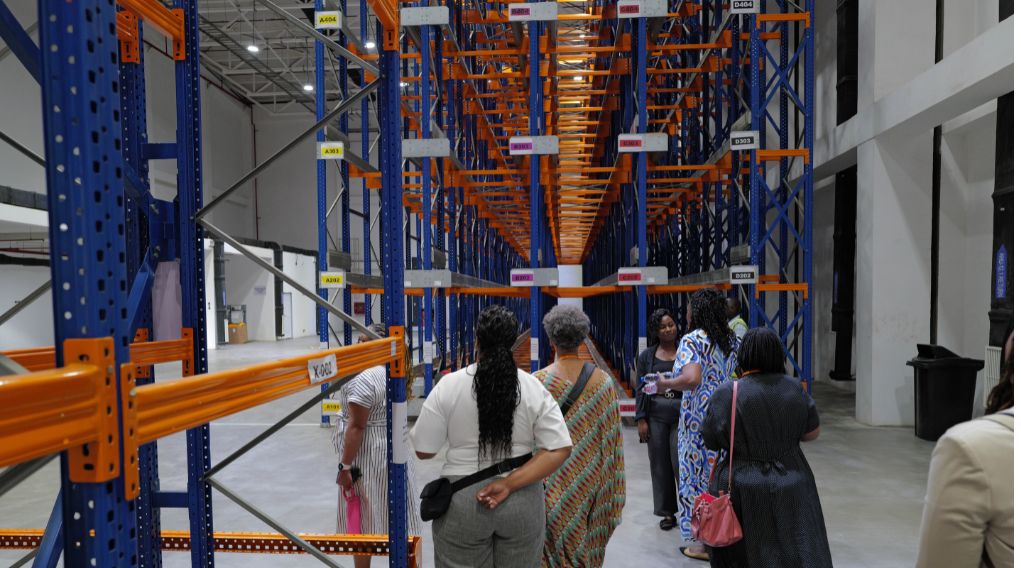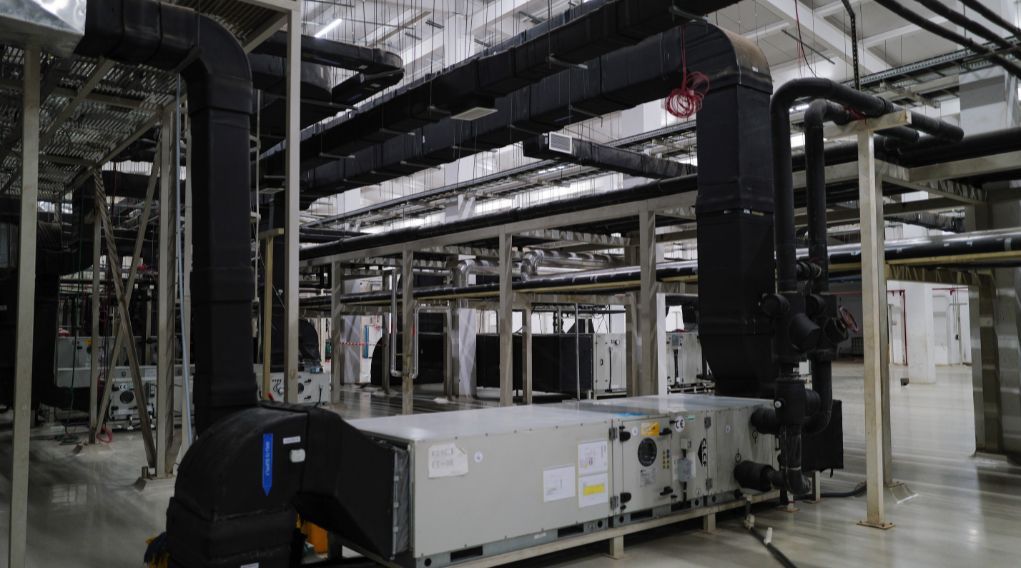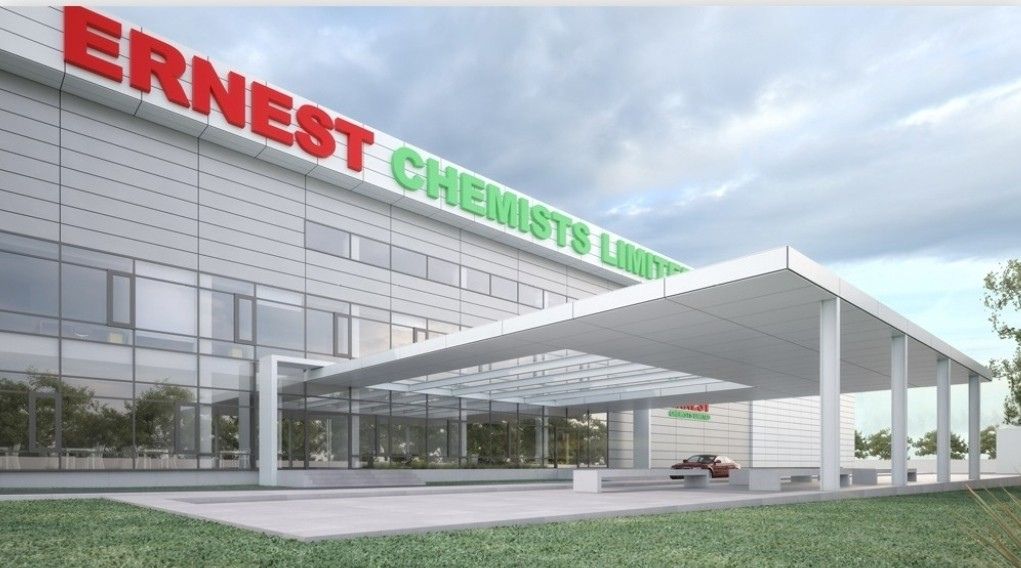
In the days leading up to the OneWe Reach’s 4th Global Conversations & Connections Summit, leaders went into the field to see what African pharmaceutical co-creation actually looks like. They found Ernest Chemists.
OneWe Reach leaders — many of whom are biopharma operators and executives with decades of experience inside the global pharmaceutical industry — made a series of boots-on-the-ground site visits across Accra in the days before the summit. The purpose of those visits was to understand, in person and at close range, how care is delivered in Ghana and what opportunities exist for the global industry to partner meaningfully on the Continent. The visits were not part of GCC. They were preparation for it. Substantive groundwork before the summit conversations begin.
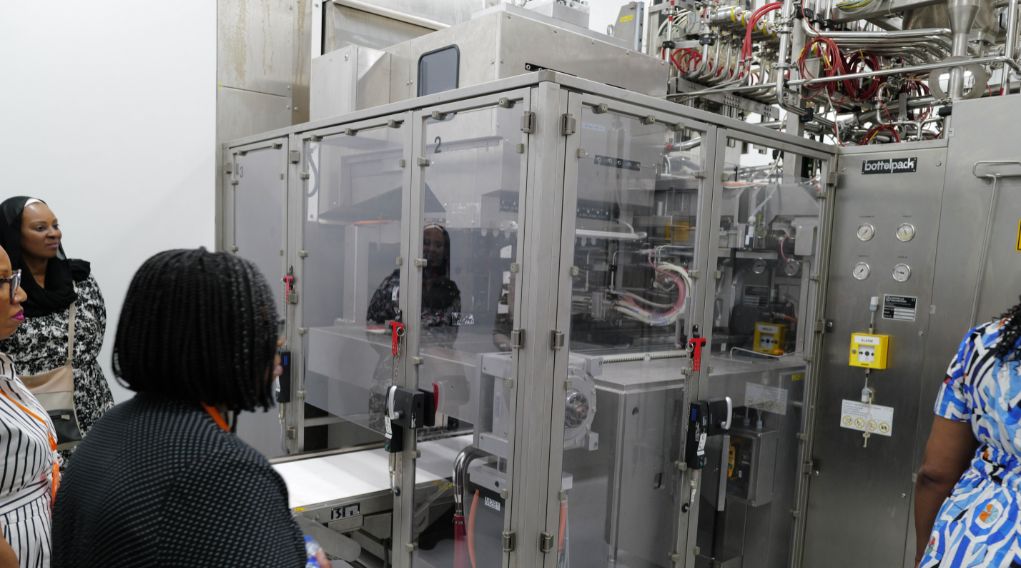
One of those visits was to Ernest Chemists Limited, where the OneWe Reach delegation toured the new European Union Good Manufacturing Practices (EU GMP) facility the company is preparing to bring online.
What Ernest Chemists Is Bringing Online
Ernest Chemists is one of Ghana’s established pharmaceutical companies. Founded in 1986 by Dr. Ernest Bediako Sampong and now led by CEO Adjoa Akyema Sampong, the wholly Ghanaian-owned company is celebrating its 40th anniversary in 2026 and employs approximately 1,500 people.
Ernest Chemists has been a contract manufacturing and packaging partner to global pharmaceutical companies for years. The company’s public materials list working relationships with GlaxoSmithKline, AstraZeneca, Roche, Novartis, Johnson & Johnson, and Merck. This matters for how the new facility should be understood. It is not Ernest Chemists’ first time working with global pharma. It is a step-change in the scope and scale of what that work can include.
The new EU GMP facility is being built to international standards. Ghana’s Minister of Health, Kwabena Mintah Akandoh, has publicly described it as “Ghana’s first state-of-the-art Good Manufacturing Practice facility” and as fully aligned with the government’s strategy to position Ghana as a pharmaceutical manufacturing hub in Africa. Ernest Chemists has stated that the facility will produce non-oral liquids — large volume parenterals (infusions), small volume parenterals, and injectables — product categories that have historically been almost entirely import-dependent across the African continent. Once commissioned, the facility is projected to operate at approximately 300% of the company’s current production capacity.
The facility is not yet operational. Production lines have not yet come online, and Ernest Chemists has not publicly committed to a commissioning date. What the OneWe Reach delegation toured was a site in the final stretch of becoming what it is being built to be.
Why the Present Moment Matters
The significance of building meaningful infusion manufacturing capacity in West Africa is difficult to overstate. Large volume parenterals (LVPs) are the backbone of hospital care — fluids, electrolytes, IV antibiotics, the medicines that keep patients alive in inpatient settings — and they are heavy, low-margin, and logistically expensive to import. Existing African manufacturing capacity for these products is concentrated in a small number of facilities, primarily in East Africa, and remains dwarfed by continental demand. West Africa in particular still imports the majority of the IV fluids it consumes, primarily from India. Bringing serious LVP manufacturing capacity into West Africa changes the unit economics of hospital care across an entire region — and reduces a supply chain dependency that has remained a strategic vulnerability for African health systems for decades.
Credibility, Capability, Capacity
What the OneWe Reach delegation saw in Accra was credibility, capability, and capacity. Credibility, because Ernest Chemists has been a contract manufacturing and packaging partner to large pharmaceutical companies, such as Johnson & Johnson, Roche and Novartis for years. Capability, because the company already operates one of the most significant pharmaceutical manufacturing footprints in West Africa. Capacity, because the new EU GMP facility extends that track record at a step-change in scope and scale — opening pathways that did not previously exist for direct contracts with global pharma sponsors and for participation in the qualified manufacturing networks of global Contract Development and Manufacturing Organizations (CDMOs) like Thermo Fisher Scientific, Lonza, and Catalent.
Ghana is primed to co-create the path forward to greater access to improved health outcomes for all. What the delegation saw in Accra is what co-creation looks like, grounded in work already done and infrastructure already built — and ready to take its place in the next chapter of innovation alongside the global pharmaceutical industry.
OneWe Reach extends its thanks to the team at Ernest Chemists for hosting the delegation, for the access, and for the seriousness of the engagement.
More from GCC throughout the week.
ABOUT GCC
The 4th Global Conversations & Connections Summit (April 16–17, 2026, Accra, Ghana) is convened by OneWe Reach through the OneWe Reach Foundation, a 501(c)(3) charitable organization. OneWe Reach is a non-profit professional infrastructure organization serving the global life sciences industry through its work to connect, cultivate, convene, and consult across the pipeline and workforce. More at onewereach.org and onewereachfoundation.org.